

EMS Is Growing Faster Than the Education Behind It.
Updated: May 15
For Fitness Professionals | By Donna Sharp, Founder, RevMethod
When my EMS suit arrived there was no education with it. Total control over the intensity with no guidance on what it was doing to the body. Then I started seeing affiliates on social media recommending suits with harmful protocols and no instruction. That is why I built this certification. - Donna Sharp, Founder, RevMethod |
EMS Is Growing Faster Than the Education Behind It. |
You have probably noticed it by now. EMS studios opening in your market. Suit companies advertising on social media. Clients asking about it. Maybe you have even tried a session yourself.
Whole-body electro muscle stimulation is one of the fastest-growing modalities in fitness. The technology is compelling, the research is genuinely impressive, and the client demand is real.
There is just one problem. The education has not kept up with the growth.
WHAT MOST TRAINERS DO NOT KNOW ABOUT EMS |
Here is the question I ask when I speak to experienced personal trainers about EMS training. "Do you know why there must be a minimum of 72 to 96 hours between WB-EMS strength sessions?"
Most do not. And that is not a reflection of their competence as trainers. It is a reflection of the fact that EMS training follows different physiological rules than conventional resistance training and nobody has taught them those rules.
In conventional resistance training, creatine kinase, which is the primary blood marker of muscle damage, typically peaks at 24 to 48 hours after a session and returns toward baseline by 72 to 96 hours. This is why many conventional programs schedule full-body sessions three times per week without issue. In whole-body EMS, creatine kinase peaks at 72 to 96 hours after a session. Not 24 to 48 hours later.
This single difference changes everything about how EMS training should be programmed. A trainer who applies conventional programming logic to EMS could schedule a second session at the exact moment the first session's muscle damage is reaching its maximum. Instead of producing adaptation they are compounding damage.
This is not a theoretical risk. A published case study documented a 1,000-fold increase in creatine kinase in a young professional footballer following a single initial EMS session with an untrained coach. The footballer was elite. The coach was experienced. Neither knew what the research required.
| 117x Creatine Kinase Increase in First High-Intensity EMS Session Teschler et al. 2016. In healthy sportive volunteers including marathon runners. Prior fitness provided no protection. |
WHY CONVENTIONAL TRAINING PRINCIPLES DO NOT TRANSFER |
The recruitment hierarchy is different
In conventional training your nervous system recruits muscle fibers from smallest to largest. Your most powerful fast-twitch fibers only activate at near-maximum voluntary effort. Most clients never consistently reach that threshold.
EMS bypasses this recruitment hierarchy entirely. The electrical impulse activates all fiber types simultaneously from the very first contraction. This produces an estimated 90 percent simultaneous fiber activation compared to 40 to 50 percent in a conventional gym session. The systemic demand on the body is fundamentally different from anything conventional programming prepares you for.
The recovery window is different
The delayed creatine kinase peak is just one example. The full recovery and adaptation window for WB-EMS runs 72 to 96 hours and this window does not shorten until after 8 to 10 weeks of progressive weekly training. A client who seems fine two days after their first session may still be in the peak damage window. Without knowing this you cannot coach them safely.
The contraindication list is different
Whole-body EMS has absolute contraindications that conventional exercise screening does not cover. Cardiac pacemakers. Implanted electronic devices. Certain neurological conditions. These are not edge cases. They disqualify a client entirely regardless of fitness level. A trainer who does not know this list before putting a client in a suit is managing real legal and medical risk.
WHY YOUR 20 YEARS OF EXPERIENCE IS AN ASSET NOT A SUBSTITUTE |
| Your 20 years makes you an exceptional EMS coach the moment you add this knowledge. Without it even the best trainer is managing a powerful tool with an incomplete understanding of how it works. |
I hear this question often from experienced trainers. "Do I really need an EMS certification? I have been doing this for years."
Yes. And here is the honest reason why.
Your experience as a personal trainer is enormously valuable. You understand movement, motivation, client relationships, and progressive programming. Those skills transfer directly to EMS coaching.
But WB-EMS requires specific knowledge that experience with conventional modalities does not provide. The CK peak timing. The introductory protocol. The contraindication list. The parameter settings that produce research-validated outcomes versus the ones that produce impressive-looking social media content with no science behind it.
The trainers who will build the most successful EMS practices over the next five years are the ones who understood early that this technology requires its own education.
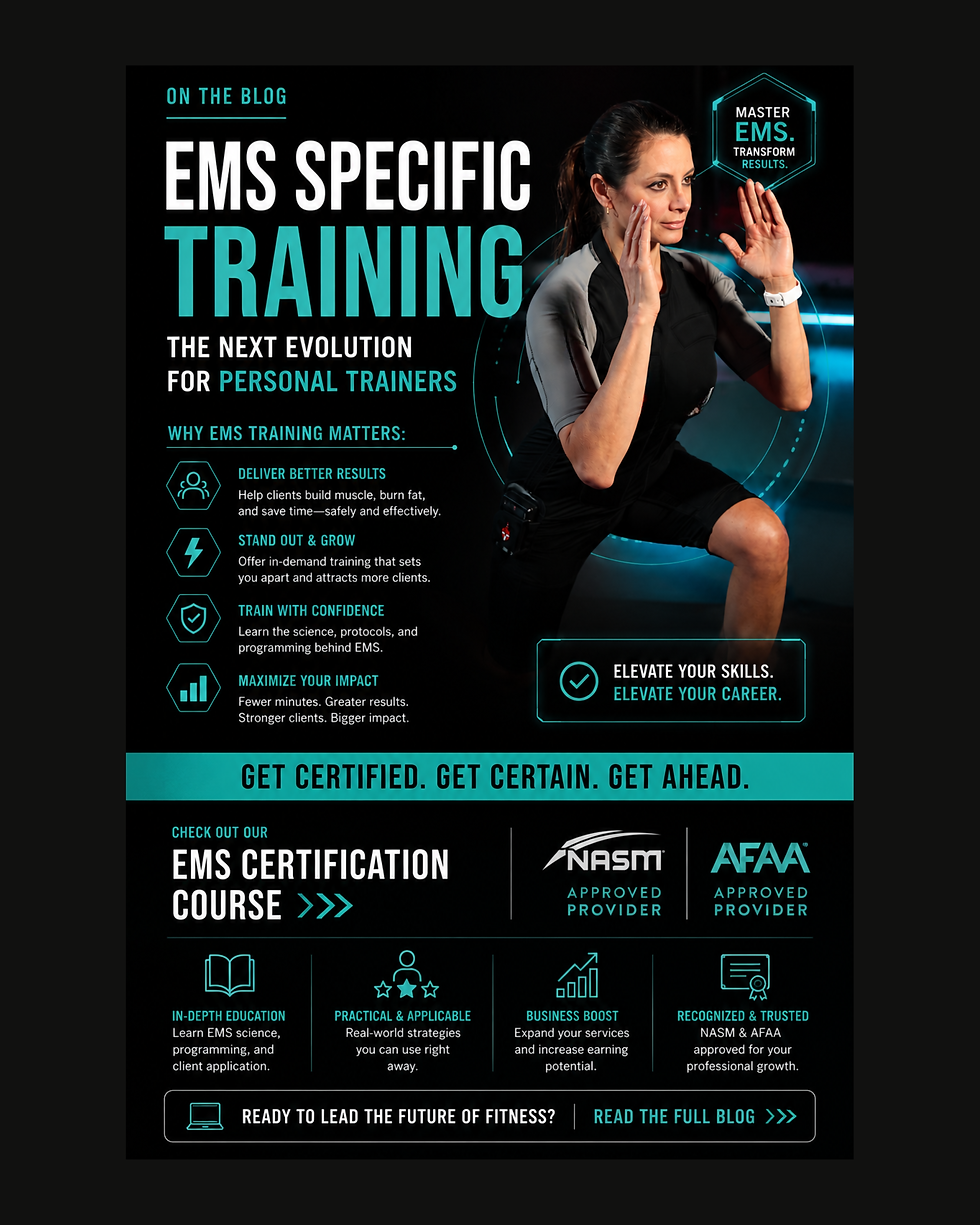
The RevMethod EMS Level 1 Certification is the only NASM and AFAA approved whole-body EMS coaching certification in the United States. RevMethod is recognized by the National Academy of Sports Medicine (NASM) and the Athletics and Fitness Association of America (AFAA) as an Approved Continuing Education Provider. 1.3 CEUs.
What You Will Learn | |
Exercise physiology of WB-EMS | How the electrical stimulus works at a neuromuscular level — why EMS activates fibers conventional training cannot reach |
Frequency, pulse width, and intensity | The three variables that control the training stimulus and what each one does |
Safety protocols | Derived directly from the published research - the CK peak timing, the introductory phase, and the contraindication list |
Client screening | How to screen every client before their first session, including the absolute and relative contraindication lists |
Session protocols | Strength, metabolic, and recovery session design at research-validated parameters |
Population-specific programming | Protocols for general fitness clients, older adults, GLP-1 patients, and athletes |
Program design | Weekly structure, progression principles, and long-term periodization |
Recovery science | Hydration, nutrition, and sleep in the context of the 72 to 96 hour EMS recovery window |
How It Works | |
Format | Self-study online course - work at your own pace with no expiry date |
Contact hours | 12.75 hours |
CEUs | 1.3 NASM and AFAA CEUs |
Modules | 6 progressive learning modules |
Practical sessions | 7 - you wear the suit yourself through the full introductory protocol (option to purchase a suit at a discount in the certification) |
Final exam | 20 questions, 80 percent passing score required |
Price | $497 |
Enrollment |
THE PART THAT SETS THIS CERTIFICATION APART |
Seven of the course requirements are practical application sessions. We encourage you to wear the suit yourself. Not just to use a video demonstration. Not just a case study review. We highly suggest you experience the technology personally, starting at the introductory protocol and progressing through to the highest-intensity session in the program.
By the time you complete the practical component you will have personally experienced every intensity level and every protocol you will use with your clients. Nothing in your coaching will be theoretical. All of it will be lived.
THE AFFILIATE OPPORTUNITY |
Every RevMethod certified coach is invited to join our affiliate program. When clients or colleagues purchase the RevMethod Preferred EMS Suit by Titan Body through your personal link they receive a $100 discount and you earn a commission per sale. This can quickly make a meaningful return on investment in your EMS business.
As someone with professional EMS knowledge your recommendation carries real weight. Clients who trust your coaching judgment will trust your suit recommendation. The certification pays dividends well beyond the credential.
| Ready to become the EMS expert your clients deserve? The RevMethod EMS Level 1 Certification is open for enrollment now. NASM and AFAA Approved. 1.3 CEUs. $497. |
RevMethod.com | Train Smarter. Get Stronger. | hello@revmethod.com © 2026 RevMethod |

Comments